
What Is GEO and AEO? A Straight Answer (Plus Everything That Guide Didn’t Tell You)
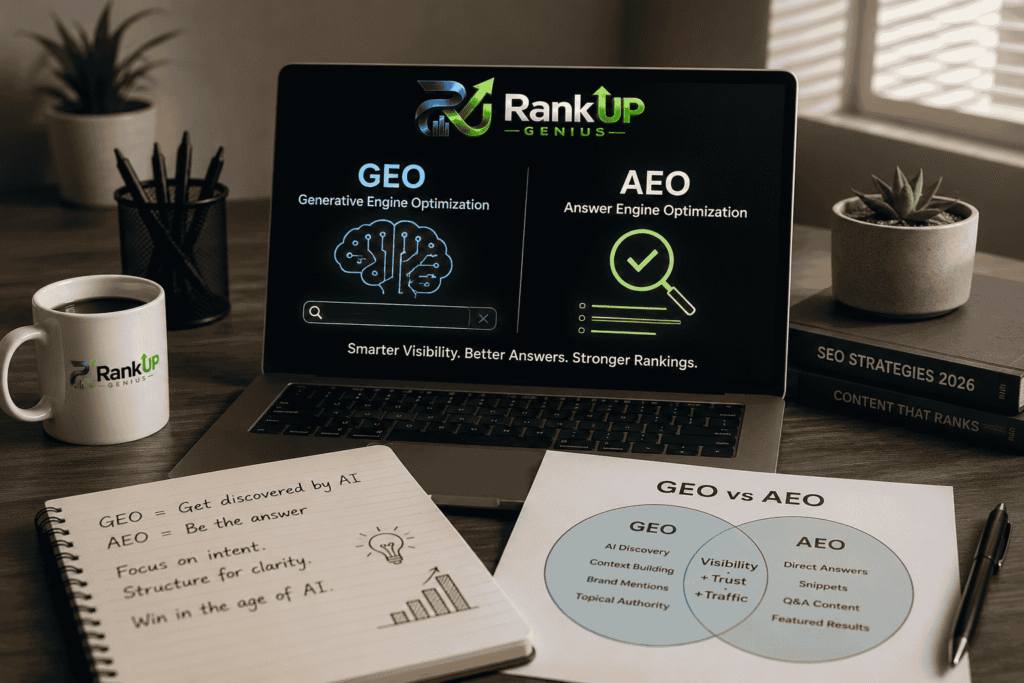
AEO (Answer Engine Optimization) is the practice of shaping your content so AI-driven answer systems — Google AI Overviews, voice assistants, featured snippets — can lift it out and hand it to a user as a direct answer. GEO (Generative Engine Optimization) is the practice of shaping your content and brand presence so large language models like ChatGPT, Gemini, Claude, and Perplexity choose to cite, quote, or reference you when they generate an answer from scratch. Both sit next to SEO, not instead of it.
That’s the whole idea in two sentences. Everything below is the part that actually matters: where these terms came from, how they’re genuinely different from each other (most articles blur this), what actually moves the needle in 2026, and a mistake almost every “GEO checklist” online is currently getting wrong.
We wrote this at Rankup Genius after running the same audit on our own clients that we’re about to walk you through — not from a template.
What Is AEO (Answer Engine Optimization)?
AEO is the older of the two terms. It grew out of the voice-search era — think Alexa, Siri, and Google Assistant reading out a single result instead of showing ten blue links — and it has since expanded to cover any system that gives someone a direct answer instead of a list of pages to click through.
An “answer engine” is any tool that tries to resolve a query itself: a featured snippet, a Google AI Overview, a “People Also Ask” box, or a spoken response from a smart speaker. AEO is about earning that one slot. Instead of competing for position one through ten, you’re competing to be the single answer a system decides to show.
In practice, that means writing content that:
- States the answer to a specific question clearly, near the top of the section
- Uses the searcher’s actual phrasing as a heading, not a clever or branded title
- Is easy to lift as a self-contained passage — a sentence or short paragraph that makes sense with zero surrounding context
- Backs itself up with real, checkable facts rather than vague marketing language
If SEO is “rank in the results,” AEO is “become the result.”
What Is GEO (Generative Engine Optimization)?
GEO is newer, and it’s solving a different problem. The term traces back to a 2023 research paper out of Princeton, Georgia Tech, and the Allen Institute for AI, which coined “Generative Engine Optimization” to describe how content creators could adjust their sites to increase visibility specifically inside AI-generated answers, as opposed to ranked search results. It’s since become the working label the marketing industry uses for optimizing toward large language models.
Here’s the distinction that most explainers skip: a generative engine like ChatGPT or Perplexity doesn’t just extract a passage the way a featured snippet does. It retrieves information from multiple sources, blends it, and writes a brand-new sentence that may combine your data with a competitor’s framing and a third source’s stat — all in one paragraph, with (sometimes) a citation link at the bottom. You’re not trying to be “the answer.” You’re trying to be one of the ingredients the model trusted enough to fold into its answer, and ideally the one it names.
That changes what “optimization” even means. GEO leans much harder on:
- Off-site signals — what’s said about your brand on Reddit, review sites, YouTube, comparison articles, and forums, since these all become training and retrieval material
- Entity clarity — making sure the model understands unambiguously what you are, who you serve, and how you differ from the ten other companies doing something similar
- Being quotable — clear claims, real numbers, named studies, and expert attribution that an LLM can safely paraphrase and attach to your name
GEO vs AEO vs SEO: Where They Actually Split
Most content treats these three as competing philosophies. They’re not. They’re three different destinations that mostly share the same road.
| SEO | AEO | GEO | |
|---|---|---|---|
| What you’re optimizing for | A ranked position on a results page | Being extracted as one direct answer | Being cited or paraphrased inside a generated response |
| Primary platforms | Google, Bing organic search | Featured snippets, AI Overviews, voice assistants | ChatGPT, Perplexity, Gemini, Claude, Copilot |
| Unit of success | Rank position, organic traffic | Answer-box appearance, zero-click visibility | Citation frequency, brand mention rate |
| Core lever | Keywords, backlinks, technical health, on-page relevance | Direct, structured, question-first answers | Off-site authority, entity clarity, quotable data |
| User action | Clicks a link | Reads the answer, may not click | Reads the answer, rarely clicks, may not even know the source |
| Measured with | Rank trackers, Search Console | Snippet/Overview appearance tracking | AI citation trackers, brand mention monitoring, share-of-voice tools |
The honest way to say it: SEO is the foundation all of this sits on. Nearly every credible industry analysis of AI Overviews has found the same pattern — a large share of the pages Google’s AI Overview cites are already ranking somewhere in the top results organically. Generative engines lean on the same crawl, the same link graph, and largely the same trust signals search engines have used for years. If your organic foundation is weak, AEO and GEO tactics have very little to work with.
Why This Is Suddenly Everywhere in 2026
This isn’t hype for hype’s sake. A few numbers explain why every marketing team is scrambling:
- A widely cited industry analysis found around 60% of Google searches now end without a click to any website, as AI-generated answers, snippets, and Overviews increasingly resolve the query on the results page itself.
- Bain & Company’s research found a large share of consumers now get a “zero-click” answer in a substantial portion of their searches — the days of ten guaranteed clicks per page-one ranking are over for many query types.
- OpenAI has reported ChatGPT’s weekly active user base climbing into the hundreds of millions in 2026, with Perplexity separately reporting hundreds of millions of monthly queries — meaningful, sustained discovery volume that never touches a traditional search engine at all.
- Analysts have repeatedly projected traditional keyword-based search volume shrinking materially over the next few years as AI-first discovery habits take hold, particularly among younger users who now open a chatbot before they open a search bar.
None of that means Google is dying — it means the definition of “search visibility” has split into three surfaces, and most businesses are still only playing on one of them.
How Answer Engines and Generative Engines Actually Decide What to Show You
It helps to understand the machinery, because it explains every tactic that follows.
Most modern answer and generative engines work in two stages. First, a retrieval step pulls a shortlist of candidate sources from an index — this part isn’t so different from classic search ranking, and it still rewards crawlability, site speed, clean HTML, and topical authority. Second, a generation step feeds those retrieved passages into a language model, which reads them and writes a new, synthesized response, deciding which sources are trustworthy enough to name.
That second step is where things get genuinely new. The model is essentially asking, sentence by sentence: Is this claim clear enough to lift? Is it backed by something checkable? Does this source sound like it knows what it’s talking about? Research analyzing millions of AI citations has consistently pointed to a few things that correlate strongly with getting picked at that stage:
- Clear author and entity credentials — a named, credible author with visible expertise outperforms anonymous or generic “Admin” bylines.
- Checkable data — specific statistics, named studies, and dates beat vague claims like “many experts agree.”
- Brand recognition beyond your own site — one large-scale analysis found brand search volume was a stronger predictor of LLM citation than raw backlink counts, meaning the conversation about you across the web matters as much as links to you.
- Structural clarity — content organized under specific, question-shaped headings is disproportionately represented in AI-generated answers compared to content buried under vague section titles like “Overview” or “Introduction.”
The FAQ Schema Myth Almost Every GEO Guide Still Repeats
Here’s something worth knowing before you implement anyone’s checklist, including ours: as of May 7, 2026, Google fully retired FAQ rich results from Search — the expandable question-and-answer dropdowns you’ve seen under search listings for years. This wasn’t a surprise overnight change; Google had already restricted FAQ rich results to a narrow set of authoritative government and health sites back in August 2023. The May 2026 update closed that loop entirely — no site, in any category, gets the visible FAQ dropdown anymore.
A lot of AEO and GEO content published even a few months ago still tells you to “add FAQ schema to win AI Overview real estate.” That advice is now outdated in the way it’s usually framed. FAQPage schema itself hasn’t been deprecated as a data type — Google has said it will keep parsing it, and other platforms including Bing, Perplexity, and various AI crawlers still read it — but it no longer buys you any visible space in a Google search result. Google’s own guidance on AI features is explicit that there’s no special schema requirement to appear in AI Overviews or AI Mode.
The practical takeaway: keep structuring your content in genuine question-and-answer form because that structure helps both readers and machine parsers understand your page. Just don’t add FAQ markup expecting a SERP rich result anymore — that specific payoff is gone, and any strategy still built around it is chasing a feature that no longer exists.
The Real Ranking Factors for AEO and GEO in 2026
Strip away the acronyms and here’s what actually correlates with getting cited, based on the pattern across independent research and citation audits:
- Answer-first writing. Put the direct answer to a question in the first sentence or two of a section, then explain. Models and snippet algorithms both favor content that doesn’t make them dig.
- Question-shaped subheadings. Analysis of large citation datasets has found headings phrased as the user’s actual question correlate more strongly with being cited than generic labels.
- Genuine E-E-A-T signals. A real named author with demonstrable experience, a visible “about” page, transparent sourcing, and content that reads like it was written by someone who has actually done the thing — this is not a checkbox; it’s the single biggest lever Google has publicly pointed marketers toward for years, and it maps almost perfectly onto what generative engines are separately learning to reward.
- Specific, sourced data. Independent research (including a Princeton-affiliated study) has found that adding concrete statistics, named sources, and direct quotations to a page measurably increases how often AI systems cite it — reported lifts in the range of 30–40% in some tests.
- Structured data that matches visible content. Article, Organization, and Product schema still carry real weight for machine understanding — as long as what’s marked up matches what a human actually sees on the page. Mismatched or invisible schema is a red flag, not a shortcut.
- Off-site brand presence. Reviews, comparison mentions, Reddit threads, YouTube explainers, and third-party roundups all feed the entity signal that generative engines lean on. Most AI citations, by several accounts, actually come from third-party mentions rather than a brand’s own website — which means digital PR and organic mentions are quietly becoming an AEO/GEO tactic in their own right.
- Crawler access. It sounds basic, but many sites accidentally block GPTBot, PerplexityBot, or OAI-SearchBot in robots.txt while trying to block scrapers. If a generative engine can’t crawl you, none of the rest matters.
- Freshness and maintenance. Citation visibility fades. Content that sat untouched for two years loses ground to a competitor who updated their page last month, even if the original was better written.
A Step-by-Step Way to Actually Implement This
- Audit where you already stand. Ask ChatGPT, Perplexity, and Google AI Mode your core category questions directly. Note whether you appear, how you’re described, and who’s cited instead of you.
- Rewrite your highest-potential pages answer-first. Pick pages that already rank reasonably well organically — remember, generative engines lean heavily on existing search performance — and move the direct answer to the top of each section.
- Turn vague headings into real questions. “Our Approach” becomes “How Does [Process] Actually Work?” Small change, disproportionate impact on extraction.
- Add real numbers, not filler. Replace “many businesses see results” with an actual figure, date, or named source wherever you can back it up honestly.
- Fix your technical layer. Confirm AI crawlers aren’t blocked, implement clean Article/Organization JSON-LD that matches your visible content, and consider publishing an llms.txt file summarizing what your site is and does for AI systems that support it.
- Build genuine off-site presence. Earn mentions on relevant comparison pages, forums, and review platforms rather than only building links back to your own domain.
- Track citations, not just rankings. Re-run your audit questions monthly. Treat this as an ongoing maintenance habit, because AI-generated visibility decays faster than organic rankings typically do.
- Keep your core SEO healthy. Site speed, crawlability, internal linking, and topical depth remain the floor everything else is built on.
Mistakes That Quietly Undo All of This
- Over-optimizing for machines at the expense of humans. If a page reads like a checklist stuffed with keywords, both Google’s helpful content systems and LLMs are increasingly good at spotting it — and neither rewards it.
- Treating GEO as a replacement for SEO. It isn’t. Every credible source in this space agrees generative engines still lean on the same crawl and trust signals traditional search has used for two decades.
- Chasing FAQ schema for SERP appearance. As covered above, that specific payoff no longer exists in Google Search as of May 2026.
- Ignoring third-party mentions. Obsessing over your own website while ignoring what Reddit, review sites, and comparison articles say about you leaves the most influential GEO lever untouched.
- Measuring the wrong thing. Watching only rank position while AI-referred visibility and citation frequency go unmeasured means you’re flying blind on two of the three surfaces that now matter.
How to Actually Measure Whether It’s Working
Traditional rank trackers won’t tell you the whole story anymore. A fuller picture includes:
- Citation and mention tracking — running your core queries through ChatGPT, Perplexity, and AI Overviews regularly and logging whether, and how, you’re mentioned
- Branded search volume — a rising trend here is one of the most reliable signals that AI-driven exposure is translating into real-world recognition
- Referral traffic segmented from AI platforms — most analytics platforms can now isolate traffic arriving from chat interfaces and AI search surfaces
- Share of voice against named competitors — not just “do we appear” but “how often do we appear relative to the two or three companies we’re actually fighting for the same query”
So, Do You Still Need “Normal” SEO?
Yes — more than ever, honestly. Every reliable analysis of this space lands on the same conclusion: SEO, AEO, and GEO aren’t three competing strategies fighting for budget. They’re three layers of the same discipline, aimed at three different surfaces where your customers now look for answers. SEO earns you the underlying authority and crawl trust. AEO turns that authority into direct-answer visibility. GEO extends it into the conversations happening inside AI tools your customers are already using instead of a search bar.
Businesses that treat this as “pick one” are the ones that’ll quietly lose visibility over the next few years — not to a single competitor, but to the shift in behavior itself.
Frequently Asked Questions
What does GEO stand for in SEO?
GEO stands for Generative Engine Optimization — the practice of optimizing content and brand presence so it gets cited or referenced inside answers generated by AI tools like ChatGPT, Gemini, Claude, and Perplexity.
What does AEO mean in marketing?
AEO stands for Answer Engine Optimization — structuring content so it can be extracted as a direct, standalone answer by systems like Google AI Overviews, featured snippets, and voice assistants.
Is GEO the same as AEO?
No, though they’re closely related and often used loosely as interchangeable. AEO is about being lifted as a direct answer by a system that mostly extracts existing content. GEO is about being one of the sources a language model synthesizes into an entirely new, generated response — often without a click at all.
Does GEO/AEO replace traditional SEO?
No. Nearly all credible research in this space finds that generative and answer engines still lean heavily on the same crawl data, backlink signals, and content authority that traditional SEO has always built. A weak SEO foundation gives GEO and AEO almost nothing to work with.
Do I still need FAQ schema in 2026?
FAQPage schema is still a valid data type and other platforms still parse it, but Google fully removed the visible FAQ rich result from Search as of May 7, 2026, for every category of site, including the government and health sites that had kept eligibility since 2023. Keep genuine Q&A structure in your content for clarity — just don’t expect FAQ markup to earn SERP space anymore.
How do I know if ChatGPT or AI Overviews are citing my site?
Run your core category questions directly through ChatGPT, Perplexity, and Google’s AI Overviews on a recurring schedule and record whether and how you’re mentioned. Several dedicated AI-citation and share-of-voice tools have also emerged specifically to automate this tracking.
What matters more for GEO — backlinks or brand mentions?
Both matter, but research into AI citation patterns has found brand search volume and third-party mentions correlating more strongly with being cited than raw backlink counts alone. Off-site conversation about your brand — reviews, comparisons, forum threads — is becoming as important as links pointing to your site.
How long does it take to see results from AEO/GEO efforts?
There’s no fixed timeline, since it depends heavily on your existing organic authority and the competitiveness of your space. Because AI citation visibility can shift faster than organic rankings, most practitioners treat this as an ongoing monthly audit rather than a one-time project.
This guide was put together by the team at Rankup Genius, where we handle keyword research, technical SEO, content strategy, and manual white-hat backlink building for B2B SaaS and ecommerce brands — with AEO and GEO now built directly into that process rather than sold as a separate add-on. If you want a straight answer on where your own site actually stands with AI answer engines, book a free audit.