
How Does Manual Link Building Differ from PBNs? (The Complete 2026 Guide)
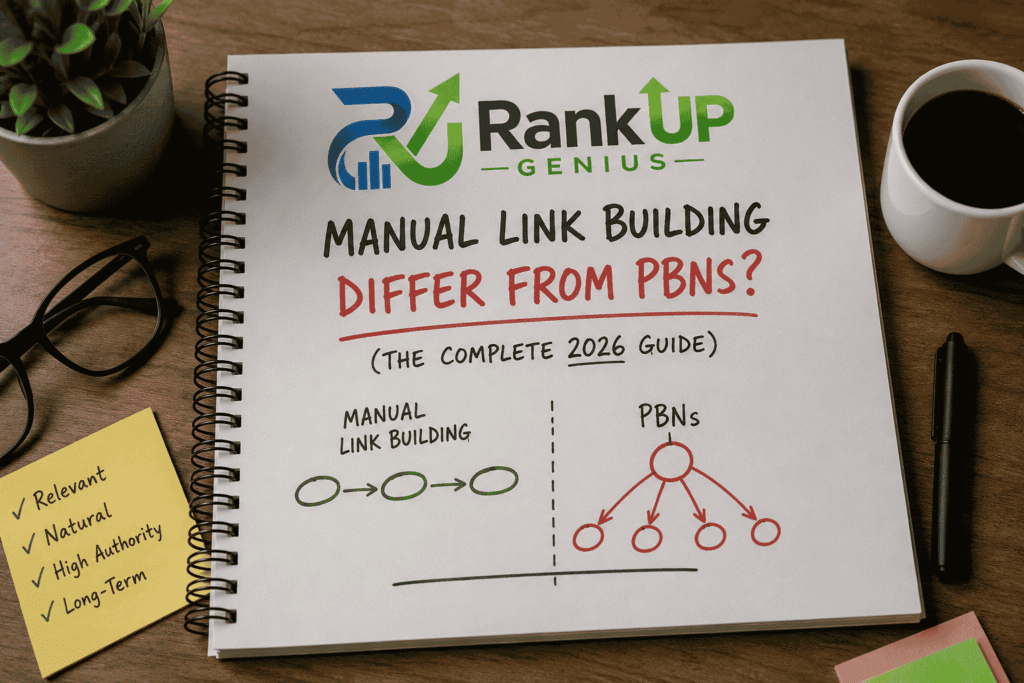
Manual link building earns backlinks through real human outreach to independent website owners and editors. Every link is placed because a real publisher chose to include it based on the quality and relevance of your content. PBNs (Private Blog Networks) are collections of websites secretly controlled by one operator, built purely to manufacture fake authority and trick Google’s algorithm. Manual links are Google-compliant, durable, and build genuine authority. PBN links violate Google’s Webmaster Guidelines, carry severe penalty risk, and can destroy years of SEO work overnight.
Introduction: The Choice That Defines Your SEO Future
You’ve probably seen both promises before.
On one side: “100 high-DA backlinks delivered in 72 hours — guaranteed rankings!”
On the other: “Manual outreach, real publishers, white-hat links that actually last.”
The price difference is dramatic. The time difference is dramatic. And for a business trying to grow, it’s genuinely tempting to wonder — does the shortcut actually work?
After 10+ years building backlinks for B2B SaaS companies, ecommerce brands, and service businesses at Rankup Genius, I can tell you that this isn’t a close comparison. The gap between manual link building and PBNs isn’t a matter of taste or risk tolerance. It’s the difference between building a business asset and renting one that can be taken away without notice.
This guide covers everything: what each approach actually is, how they work mechanically, what Google does about PBNs in 2026, how to spot one in the wild, and why manual link building is the only strategy worth investing in for long-term search visibility — including visibility in Google AI Overviews and generative AI tools like ChatGPT and Perplexity.
What Is Manual Link Building? (And How Does It Actually Work?)
Manual link building is exactly what it sounds like: a person — a real human being — researches potential link opportunities, reaches out to website owners or editors, and earns a backlink by providing genuine value. No software places the link automatically. No network exists to sell you placements by the batch. Every link is the result of a conversation, a pitch, or a published piece of content that earned its place.
At Rankup Genius, when we build a link, here’s what actually happens:
Step 1 — Prospecting. A team member manually researches websites that are topically relevant to your niche, have real organic traffic (not just a high DA score), and demonstrate editorial standards — meaning they don’t accept every submission or link request that comes their way.
Step 2 — Qualification. We verify that the site has real human readers, genuine organic search visibility, and a backlink profile that isn’t itself built on spam. A DR 50 site that sells placements to anyone who pays is worth less than a DR 35 site that carefully curates its outbound links.
Step 3 — Personalised outreach. We write individual pitches tailored to each publisher. Generic “dear webmaster” templates go to the spam folder. Real outreach explains the specific value your content brings to their specific audience.
Step 4 — Content creation. Most placements require original, high-quality content. We write it — properly, with depth and editorial care — because low-quality guest content gets rejected by legitimate publishers, and rightfully so.
Step 5 — Placement and reporting. Once the link goes live, we verify it, document it, and report back with full transparency: the live URL, the referring domain’s metrics, the anchor text used, and the placement context.
That’s the process. It’s slower than pushing a button and getting 200 links from a dashboard. And it’s worth every minute of the difference.
What Is a PBN? (Private Blog Network Explained)
A Private Blog Network is a collection of websites that are secretly controlled by the same person or company, built specifically to sell or place backlinks pointing to a “money site” — the site they actually want to rank.
Here’s how most PBNs are constructed:
Acquiring expired domains. PBN operators buy domains that previously had strong backlink profiles — sites that built genuine authority before they were abandoned. The idea is that the existing authority transfers to the new sites when they’re re-published.
Building out fake websites. Each domain gets a new website, usually populated with thin content or AI-generated articles. The sites look like independent blogs or information resources, but they have no real editorial agenda and no genuine readership.
Hiding ownership. This is where it gets deceptive. PBN operators go to significant lengths to make these sites look unrelated: different hosting providers, different registrars, WHOIS privacy protection, varied WordPress themes and plugins, separate Google Analytics accounts. The whole effort is designed to fool Google into thinking these are genuinely independent publishers.
Selling or placing backlinks. The network then sells links from these sites to clients — or places links to their own money site — with full control over anchor text, placement, and volume.
The appeal is obvious: you get to control where your links come from, what anchor text they use, and how many you get. Speed, scale, and the illusion of control. But every single element of this system is designed to deceive, and Google has spent years getting very good at seeing through it.
The Core Difference: Editorial Legitimacy
The fundamental distinction between manual link building and PBNs comes down to one thing: editorial legitimacy.
A manually built link gets placed because a human editor or publisher decided your content was worth linking to. That decision reflects their judgment, their editorial standards, and their commitment to their readers. It’s a genuine vote of confidence.
A PBN link gets placed because someone paid for it or controls the site doing the linking. No editor made a judgment call. No reader benefits from the recommendation. The entire signal is manufactured.
Google’s link evaluation systems are designed to reward the first type and punish the second. The reason Google cares about links at all is that genuine editorial recommendations from trusted sources carry real information about quality and authority. A PBN link contains no such information — it’s noise dressed up as signal.
This matters more in 2026 than it ever has before. Google’s SpamBrain AI system, which has been continuously developed and updated since 2022, is now trained specifically to distinguish editorial links from manufactured ones — not just by looking at individual links, but by analyzing patterns across entire domains and networks.
How Google Detects PBNs in 2026
Google’s ability to find and penalize PBNs has reached a level of sophistication that most people running PBNs drastically underestimate. Here’s what SpamBrain and Google’s manual review teams actually look for:
1. Shared Infrastructure Footprints
Even with different registrars and hosting providers, PBN operators leave traces. Shared IP address blocks or ASNs (Autonomous System Numbers) across supposedly independent sites. Nameserver patterns that cluster together. SSL certificates from the same provider registered in the same time window. These infrastructure signals create a map of the network even when the surface-level diversity looks convincing.
2. WHOIS and Ownership Patterns
As of January 2025, RDAP (the replacement for WHOIS) provides structured, machine-readable ownership data that Google can process at scale. Domains registered through the same registrar account, with the same contact data, in the same time window, are a clear signal. Even with privacy protection enabled, a batch of domains that all activated privacy settings on the same day is itself a detectable pattern.
3. Content and Authorship Signals
Google’s machine learning systems can now detect writing patterns across supposedly independent sites — repetitive sentence structures, topical overlap, reused article formats, AI-generated content characteristics. If 30 sites that claim to be independent all publish content with the same structural fingerprint, that’s a network, not a coincidence.
4. Link Graph Anomalies
The most reliable signal of all: the pattern of what a site links to. A legitimate blog links to many different sites across many different topics over time. A PBN site links to a small set of commercial money sites with exact-match anchor text, with high outbound dofollow density, in a concentrated time window. Google’s link graph analysis can identify these hub-and-spoke patterns at scale — and they’re essentially impossible to hide when you’re operating hundreds of sites in a coordinated network.
5. Engagement and Behavior Signals
Real websites have real readers who click on links, return to read new content, and engage in ways that generate behavioral signals Google can observe. PBN sites have no genuine readership. Traffic is minimal or fake. Engagement metrics are absent. These behavioral signals increasingly factor into how Google evaluates whether a linking site has real authority — not just on paper, but in practice.
The result: in 2026, SpamBrain flags suspicious link patterns in something approaching real time. Penalties that used to take months to materialize now surface in hours or days following a major spam update.
The Real Costs of PBNs (That Nobody Shows You in the Sales Pitch)
When someone offers you 100 backlinks for $50, they show you the upside. They don’t show you what happens when it goes wrong — and in 2026, it will go wrong.
Algorithmic Devaluation
The most common outcome is quiet devaluation. Google identifies the PBN links as spam and simply ignores them. Your rankings don’t improve, but you don’t necessarily get penalized either. You’ve spent money on links that do nothing. This is actually the best-case scenario with PBNs.
Manual Actions
A human reviewer at Google can issue a manual action against your site for unnatural inbound links. When this happens, you receive a notification in Google Search Console, and your rankings can drop dramatically or disappear from search results entirely. Recovering requires disavowing the toxic links, filing a reconsideration request, waiting for Google to review it (which can take months), and then rebuilding from scratch.
Algorithmic Penalties
SpamBrain can apply automated penalties that drop your rankings without any notification in Search Console. There’s no appeal process for these. Your traffic falls, you see nothing in Search Console explaining why, and the only path forward is cleaning up your link profile and waiting for the next algorithm update to recognize your cleanup.
Cascading Network Collapse
When Google deindexes a PBN network — which it does, regularly, in batches — every link from that network disappears simultaneously. If you built 200 links over a year and they all vanish in a single update, you don’t just lose the links. You often see a ranking collapse because the sudden loss of a large portion of your link profile triggers further algorithmic scrutiny.
One real pattern we see repeatedly at Rankup Genius: new clients come to us after exactly this scenario. They spent $300 on PBN links in January, ranked briefly in March, then crashed in April when the spam update hit. We then spend months doing cleanup work before we can start building genuine authority. The total cost — the $300, the cleanup time, the lost revenue during the ranking drop, and the time to rebuild — dwarfs what manual link building would have cost from the start.
Reputation Risk
If you’re running an agency, a SaaS product, or any business where clients research you before buying, being caught using PBNs carries reputational consequences that outlast any algorithmic penalty. Competitors can find and report PBN networks. Industry peers notice. Your brand’s credibility in SEO-adjacent spaces depends partly on the methods you use.
What Manual Link Building Actually Delivers
The reason Rankup Genius has built our entire service around manual, white-hat link building is simple: it’s the only approach that delivers lasting results without putting our clients’ domains at risk. Here’s what genuine manual link building produces:
Links That Survive Algorithm Updates
A link placed editorially on a real, independent website by a real publisher doesn’t become a liability when Google updates its spam detection. It stays. This is why our backlink placements come with a 12-month replacement guarantee — not because we expect them to disappear, but because we’re confident enough in our standards that we can stand behind the work.
Authority That Compounds
Genuine editorial links build domain authority in a way that compounds over time. Each link from a trusted source makes your site slightly more authoritative, which makes your next piece of content slightly more likely to rank, which makes your outreach slightly more credible to the next publisher. PBN links, at best, produce a temporary spike. Manual links produce a trajectory.
AI Visibility Benefits
This is increasingly important in 2026 and beyond. Google’s AI Overviews, ChatGPT, Perplexity, and other generative AI tools use backlink authority as a key signal when deciding which sources to cite. Sites with genuine editorial link profiles are far more likely to appear in AI-generated answers than sites that artificially inflated their metrics through PBNs. The AI visibility benefit of manual link building is real, growing, and directly relevant to how your business gets found as AI search reshapes search behavior.
Transparent Reporting
With every manual link we build, we provide complete reporting: the live URL, the referring domain metrics, the anchor text, and the placement context. You can visit every link we build, verify it exists, and evaluate it yourself. There’s nothing to hide when every link is legitimate.
The 5 White-Hat Link Building Methods That Replace PBNs
If PBNs are off the table — and they should be — here are the legitimate strategies that actually work in 2026:
1. Guest Post Outreach
Writing genuinely useful, original content for real publications in your niche. The keyword is genuinely — editors at quality publications can spot content written purely for a link, and they reject it. Content that serves the host publication’s readers earns placement and earns the link.
2. Niche Edits (Contextual Link Insertion)
Identifying existing, published content on relevant sites that could benefit from a link to your resource, then reaching out with a specific pitch. This works best when your content genuinely adds value to the existing article — not when you’re just trying to insert a link into whatever you can find.
3. Broken Link Building
Finding dead links on relevant pages and offering your content as a working replacement. Site owners actively benefit from this because broken links are bad for user experience. You’re solving a real problem, which makes your pitch easy to say yes to.
4. Digital PR and Data-Driven Content
Creating original research, data studies, or expert commentary that journalists and bloggers want to cite. This is the highest-authority approach — the links you earn from real publications through genuine editorial coverage are the strongest signals Google and AI systems process.
5. Resource Page Outreach
Identifying curated resource pages in your niche — pages that link to the best tools, guides, and references on a topic — and pitching your content for inclusion. These pages exist specifically to recommend good resources, which means the outreach friction is lower than cold guest post pitching.
All five of these approaches take more time than buying PBN links. All five of them build something real.
FAQ: What People Actually Ask About Manual Links vs PBNs
Q: Are PBNs ever safe to use?
The honest answer is no — not for any business that has a long-term interest in its search rankings. Some SEOs argue that “high quality” PBNs with diverse hosting and good content can avoid detection. The problem is that the detection risk compounds over time as Google’s AI systems improve, and a PBN that avoided detection for 12 months can still be identified and deindexed in a future update. The ceiling of the upside is a temporary ranking boost. The floor of the downside is permanent deindexation.
Q: How long does manual link building take to show results?
Manual link building typically starts showing measurable ranking impact within 4 to 12 weeks of the first links going live, depending on the competitiveness of your niche and the authority of the acquired links. This is slower than the initial spike you sometimes see from PBN links, but the impact is cumulative and durable rather than temporary and reversible.
Q: Can I tell if a backlink service is using PBNs?
Yes, with some investigation. Ask for sample domains before you pay. Run those domains through Ahrefs or SEMrush and look at their traffic — real sites have real organic visitors. Check when they were registered versus when their content was published. Look at what else they link to. If a site links to dozens of different niches with commercial anchor text and has no organic traffic, it’s a PBN site.
Q: What should I do if I already have PBN links pointing to my site?
Use Google’s Disavow Tool to tell Google to ignore those links, then focus your link-building budget on genuine manual outreach. If you received a manual action in Search Console, disavow the links, fix any other guideline violations, then submit a reconsideration request. Recovery takes time, but it’s achievable.
Q: Is manual link building worth the higher cost per link?
Yes — but the comparison isn’t really “cost per link.” It’s cost per durable ranking improvement versus cost per temporary ranking spike plus the risk of a catastrophic penalty. Measured that way, the economics of manual link building are significantly better than PBNs, especially over a 12- to 24-month time horizon.
Q: Does Rankup Genius use any PBNs?
Never. Zero tolerance — it’s in our service guarantee. Every link we build is researched, prospected, and placed by hand on independent, editorial sites with real traffic and real editorial standards. We back this with a 12-month replacement guarantee on every placement, because we’re confident in what we build.
How to Evaluate Any Link Building Service Before You Buy
Whether you work with Rankup Genius or someone else, here’s the standard every link building service should meet before you hand over money:
Ask for sample domains — not a list of metrics, actual live URLs. Visit them. Read the content. Check if they look like real websites or content-thin placeholder sites.
Check for organic traffic — use Ahrefs, SEMrush, or even a free tool. A site with a DR of 40 and 200 monthly organic visitors is almost certainly a PBN site. Legitimate publishers have readers.
Request full reporting transparency — you should receive live URLs, anchor text, placement context, and domain metrics for every single link. If an agency can’t tell you exactly where your links live, they’re hiding something.
Look for realistic timelines — real link building takes weeks, not hours. Any service promising 100 links in 48 hours is not doing manual outreach.
Check for a guarantee — not a “satisfaction guarantee” that lets them deliver anything and claim you’re satisfied, but a specific replacement guarantee tied to link placement longevity.
The Bottom Line
Manual link building and PBNs are not two different risk profiles for achieving the same goal. They’re two entirely different philosophies about what SEO actually is.
PBNs treat Google as an adversary to be tricked. Manual link building treats Google as a system designed to reward genuine quality and authority — which is exactly what it is.
The businesses that own their search rankings in 2026 are the ones that built something real: genuine relationships with publishers, real editorial endorsements from authoritative sources, and a link profile that looks the same to Google’s algorithm as it does to a human auditor, because it was built the same way.
That’s what we build at Rankup Genius. Hand-researched, hand-placed, spam-free manual backlinks — backed by a 12-month replacement guarantee and full transparency on every placement.
If you’ve been burned by PBN services before, or if you’re just starting to build your link profile and want to do it right from day one, we’d like to help.
Get Your Free SEO Audit — we’ll show you exactly where your link profile stands and what a genuine manual link-building strategy would look like for your site.
Written by M Abrar Haider, CEO & Lead Strategist at Rankup Genius. 10+ years of hands-on SEO experience building white-hat backlink campaigns for B2B SaaS, ecommerce, and service businesses.
Last updated: July 2026