
Small Business SEO Services: What’s Included, What They Cost, and How to Choose
If you’ve started asking around about SEO for your business, you’ve probably noticed that no two quotes look alike. One provider offers a $300 monthly package. Another wants $4,000 a month and a six-month commitment. A third promises page-one rankings in thirty days. None of that is necessarily a scam — but none of it tells you what you’re actually buying, either.
SEO isn’t a single product. It’s a bundle of related work — technical fixes, content, links, local listings, reporting — and the right mix depends on your industry, your competition, and how much of the work you’re already doing yourself. This guide breaks that bundle apart so you can read a proposal, compare it against a realistic budget, and ask the right questions before you sign anything.
What Do Small Business SEO Services Actually Include?
A legitimate small business SEO service is rarely just “link building” or just “content.” It’s a recurring cycle of research, fixes, and publishing, built around a few core components:
- Technical audit — checking crawlability, indexing, page speed, mobile usability, broken links, and duplicate content. This is the foundation; content and links don’t help much if Google can’t crawl or trust the site.
- Keyword and competitor research — identifying the terms your customers actually search, matched to search intent, and mapped against what competitors already rank for.
- On-page optimization — titles, meta descriptions, headings, internal linking, and structured data on individual pages so search engines (and readers) understand what each page is about.
- Content strategy — new pages or blog posts that answer real customer questions, plus updates to existing content that’s thin, outdated, or ranking below its potential.
- Local SEO — Google Business Profile optimization, citation consistency (your business name, address, and phone number matching across directories), and review management, for businesses that serve customers in a specific area.
- Link building — earning links from other relevant websites, which still functions as a trust signal for both Google and AI-driven search tools.
- Reporting — regular updates on rankings, traffic, and what was actually done, ideally tied to leads or revenue rather than vanity metrics alone.
Not every small business needs all seven working at full intensity from day one. A brand-new local service business usually gets more value from local SEO and on-page fixes first; an established e-commerce store might already have those covered and need content and link building instead. A capable provider scopes the mix to your situation instead of selling the same package to everyone. Rankup Genius’s monthly SEO plans illustrate this tiered approach, scaling keyword coverage, content volume, and link volume across plan levels rather than treating every client identically.
How Much Do Small Business SEO Services Cost?
Pricing varies more than almost any other marketing service, mainly because “SEO” covers such different scopes of work. The clearest current benchmark comes from Ahrefs’ 2026 pricing survey of 439 SEO providers worldwide, which found:
| Pricing Model | Typical Range | Notes |
|---|---|---|
| Monthly retainer | $500–$5,000+/mo (average $2,917/mo) | Most common model — used by roughly 78% of providers |
| Local SEO retainer | ~$1,557/mo average | Narrower scope; single-location or service-area businesses |
| Freelancer retainer | ~$1,348/mo average | Lower overhead, but capacity is limited to one person |
| Agency retainer | ~$3,209/mo average | Broader team (technical, content, outreach specialists) |
| Hourly consulting | ~$111/hr average | Best for audits, second opinions, or in-house team coaching |
| One-off project | $2,500–$5,000 typical band | Site migrations, recovery from a penalty, one-time audits |
A large share of the market — roughly a quarter of providers, per that same survey — charges between $500 and $1,000 a month, which usually buys a narrower scope: on-page fixes and light local SEO, without much original content or outreach-based link building. That’s not automatically a bad deal; it depends on whether it matches what your site actually needs right now.
Be cautious of performance-based or “pay per ranking” pricing. It sounds appealing because you only pay for results, but no provider controls Google’s algorithm, so these arrangements tend to push toward narrow, easy-to-game keywords rather than the ones that actually bring in customers.
As a point of reference, Rankup Genius’s own published backlink packages start at $30 for a standalone link-building order, while its monthly SEO plans run $299–$699 depending on scope — toward the lower-to-middle end of the ranges above, reflecting a narrower initial scope rather than a full enterprise-level program. Whatever provider you’re evaluating, ask what specifically is included at that price before comparing it to any industry average.
SEO Agency vs. Freelance SEO Consultant vs. DIY: Which Fits Your Business?
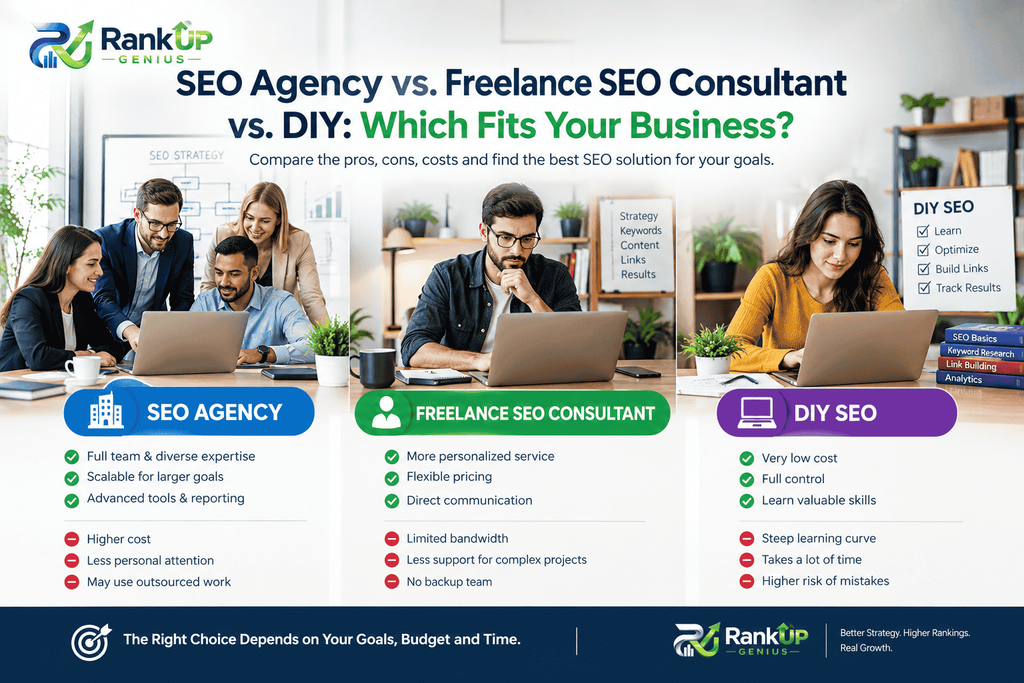
There’s no universally “best” option here — it depends on your budget, your time, and how competitive your market is.
| SEO Agency | Freelance Consultant | DIY / In-House | |
|---|---|---|---|
| Typical cost | $1,500–$10,000+/mo | $500–$3,500/mo | Your time + tool costs (~$50–$300/mo) |
| Best for | Competitive niches, multiple service lines, businesses that want one team handling strategy and execution | Single-location businesses, tighter budgets, businesses that want more direct access to the person doing the work | Very low competition keywords, businesses with in-house marketing time, or as a bridge before hiring |
| Team access | Multiple specialists (technical, content, outreach) | One person, usually generalist | Whoever inside the business takes it on |
| Scalability | Easier to scale up content and links quickly | Limited by one person’s capacity | Slowest to scale |
| Main trade-off | Higher cost; less individual attention than a solo consultant | Capacity ceiling if the business grows fast | Requires real time investment and a learning curve |
A reasonable rule of thumb: if your market has real competition (multiple established businesses already ranking for your core terms), a DIY approach usually can’t move fast enough to matter. If your niche and geography are narrow, a motivated owner following Google’s own SEO Starter Guide can get a surprising amount done before it makes sense to pay for outside help.
How Long Does Small Business SEO Take to Work?
Longer than most people expect, and there’s no way to shortcut that honestly. Google’s own guidance for anyone considering hiring an SEO puts realistic timelines at four months to a year before meaningful changes show up, and that’s for changes made correctly on a site with no major technical problems.
In practice, most small business SEO programs follow a rough arc:
- Weeks 1–4: Audit, research, and quick technical fixes. Some long-tail keywords may start moving if the site had obvious problems.
- Weeks 4–12: On-page rollout and the first round of content and links. This is usually the quietest period — work is happening, but rankings haven’t caught up yet.
- Months 3–6: Compounding effects start to show. Target keywords typically begin climbing, and traffic growth becomes visible in reporting.
- Month 6 onward: Rankings for competitive terms stabilize, and the program shifts toward defending positions and expanding into adjacent keyword clusters.
Anyone promising first-page rankings within days or weeks for a term with real competition is either describing a low-competition, low-value keyword or not being straight with you.
How to Vet a Small Business SEO Company (Checklist)
Google publishes its own interview questions for anyone hiring an SEO, and they hold up well as a starting checklist:
- Can they show examples of past work and explain what they actually did, not just the outcome?
- Do they describe following Google’s Search Essentials (its public guidelines), and can they explain a technique before using it on your site?
- What results do they expect, on what timeline, and how will they measure it?
- Will they request read-only access to Google Search Console and Analytics rather than full account ownership?
- Do they explain trade-offs and risks, or only upside?
Red flags worth walking away from, based on patterns documented by Google and repeated across independent reporting on SEO scams:
- A guarantee of a #1 ranking or first-page placement by a specific date. No one controls Google’s algorithm, including the people selling the guarantee.
- Vague deliverables — “we’ll do SEO for you” without a specific list of tasks, keywords, or pages.
- Unsolicited emails claiming your site has urgent, unspecified “SEO issues.”
- Bulk, cheap backlink packages with no explanation of where the links come from. If you want to understand why that matters, how manual link building differs from PBNs is worth reading before you buy any backlink package.
- Pressure to sign a long contract before they’ve even looked at your site.
None of this means every affordable provider is untrustworthy — plenty of legitimate small business SEO consultants charge modest rates. The distinction is whether they can explain, in specific terms, what they’ll do and why.
Local SEO for Small Businesses: Why It’s Often the Fastest Win
If your business serves customers in a specific city or region, local SEO usually delivers visible results faster than broad, national SEO — partly because the competition is smaller, and partly because Google treats “near me” and location-based searches differently from general queries.
The core pieces:
- Google Business Profile — a complete, accurate, regularly updated profile with correct hours, categories, photos, and a steady flow of genuine reviews.
- NAP consistency — your business Name, Address, and Phone number matching exactly across your website, directories, and social profiles. Mismatches quietly undermine trust signals.
- Location-specific pages — for businesses serving multiple areas, a genuinely useful page per location (not a template with the city name swapped in) tends to outperform a single generic page.
- Local links and mentions — coverage from local news outlets, chamber of commerce listings, and partnerships with other local businesses.
Local SEO averages roughly $1,557 a month according to the Ahrefs survey cited above — meaningfully less than broad national SEO, since the scope is narrower and the competition set is smaller.
Common Small Business SEO Mistakes That Waste Budget
A few patterns show up repeatedly, regardless of provider:
- Treating SEO as a one-time project. A single audit or redesign creates a temporary bump; rankings decay without ongoing content, links, and technical maintenance.
- Chasing high-volume keywords with no buying intent. Ranking for a broad term with no commercial intent can look good in a report while doing nothing for revenue.
- No tracking beyond rankings. Rankings without a way to connect them to leads or sales make it impossible to judge whether the spend is working.
- Buying volume over quality in backlinks. Thousands of low-quality, automated links can do more harm than good; a smaller number of relevant, manually placed links tends to hold up better through algorithm updates.
- Ignoring technical basics. Content and links struggle to help a site that’s slow, not mobile-friendly, or has indexing problems.
AEO and GEO: Why “Ranking” Isn’t the Whole Story Anymore
Search results in 2026 don’t only mean a list of blue links. Google’s AI Overviews, along with tools like ChatGPT, Gemini, and Perplexity, now answer many queries directly, sometimes without the user clicking through to a website at all. Two related practices have grown out of this shift:
- AEO (Answer Engine Optimization) — structuring content so a system can lift out a direct, self-contained answer: clear questions, concise answers, and information presented in a scannable, unambiguous way.
- GEO (Generative Engine Optimization) — making sure AI systems can understand, trust, and cite your content as a source, through clear factual statements, defined entities, and credible sourcing.
Neither replaces traditional SEO; they build on the same foundation of technical health, relevant content, and trust signals. And no provider can promise a specific citation inside an AI Overview or a ChatGPT answer — that placement is determined by the platform, not purchased or guaranteed. For a deeper look at how the two concepts differ in practice, see what AEO and GEO actually mean.
One structured-data note worth knowing if you’re implementing any of this yourself: Google stopped displaying FAQ rich results in Google Search as of May 7, 2026, for all sites, including the government and health sites that had retained eligibility since 2023. FAQPage schema is still valid and won’t hurt a page, but it no longer produces the expandable Q&A snippet many older SEO guides still describe. A well-written, answer-first FAQ section still helps readers and may help AI systems parse a page — it just won’t earn a distinct rich result in Google anymore.
Frequently Asked Questions
What do small business SEO services include?
Most programs combine a technical audit, keyword research, on-page optimization, content strategy, local SEO (if relevant), manual link building, and monthly reporting. The exact mix depends on the provider and your site’s starting condition — ask for a specific list of deliverables rather than a general description.
How much do small business SEO services cost?
Most small businesses pay between $500 and $2,500 a month for retainer-based SEO, based on Ahrefs’ 2026 survey of 439 providers. Freelancers average around $1,348/month, agencies around $3,209/month, and local-focused SEO averages roughly $1,557/month.
How long does small business SEO take to show results?
Google’s own guidance suggests four months to a year for meaningful, durable results. Early technical fixes and low-competition local terms can move within weeks, but competitive national keywords typically take longer and depend heavily on how much authority competing sites already have.
Should I hire an SEO agency, a freelance consultant, or do it myself?
Agencies suit competitive niches needing multiple specialists; consultants suit tighter budgets that still want expert hands-on work; DIY can work for low-competition local businesses with time to invest. The right choice depends on your budget, competition level, and available time.
What’s the difference between local SEO and general SEO for a small business?
Local SEO focuses on Google Business Profile, location pages, citations, and reviews to win “near me” and city-specific searches. General SEO targets broader, often non-location-based keywords. Most local businesses need both, weighted toward local first.
What red flags suggest an SEO company isn’t trustworthy?
Guaranteed #1 rankings, vague deliverables, unsolicited “urgent SEO issue” emails, bulk cheap backlink packages with no source transparency, and pressure to sign long contracts before an audit are all documented warning signs.
Can any SEO company guarantee a #1 Google ranking?
No legitimate provider can guarantee this. Google’s own hiring guidance states plainly that if an SEO guarantees first-place rankings, you should find someone else, since no company controls Google’s ranking algorithm.
Do small businesses need to worry about AI search (AEO/GEO), or just Google?
Both matter, but they share the same foundation: accurate, well-structured, trustworthy content. There’s no separate program needed — solid SEO fundamentals also support visibility in AI-generated answers, though no citation inside an AI answer can be guaranteed.
Does adding FAQ schema to my website still help me rank?
Not for the visible rich result it used to produce — Google stopped showing FAQ rich results in Search as of May 2026 for all sites. The markup itself remains valid and harmless, and a clear, answer-first FAQ section is still useful for readers, but it no longer creates a distinct SERP enhancement.
Conclusion
The honest version of “how do I pick small business SEO services” comes down to matching scope to budget and being skeptical of anyone who skips the audit and jumps straight to a guarantee. A fair provider can tell you exactly what they’ll do, roughly how long it will take, and what it will realistically cost — and they’ll say so before asking for a signature.
If you want a second opinion on what a realistic scope and budget look like for your specific site, Rankup Genius offers a free SEO consultation to walk through it.